
Prediction for 2026 - Intent Data to Flourish
MyTerms (PDC-INTENT) + Agentic Commerce = Rocketfuel for Growth

I have one simple prediction to put out there for 2026….
Here it is…
I believe that the launch of the MyTerms standard, aka IEEE P7012, will see Intent data emerge as a powerful force for good. And, if handled well, be a driver of economic growth.
So, what is it intent data? How will it further emerge in 2026? And what differences will it make?
Intent data defined
Intent, or intention, data has long been recognised as a significant source of value. Doc Searls triggered a focus on the matter in his book (The Intention Economy) on the subject back in 2012. Doc points to the customer-side nature of Intention data; more on that below.
More typically however, over the last decade, intent data has been used by the supply/ organisation side of the market. It is seen as forward-looking, predictive, information such as website visits, content downloads, and search queries—that provide insight into the interests, needs, and potential purchase intentions of individuals. This data theoretically helps identify which people are “in-market” and actively researching solutions, allowing sales and marketing teams to prioritise leads and personalise outreach. Intent data is often associated with ‘buying things’; but can equally well apply to other aspects of life such as looking for a new job, checking out college courses, researching medical issues and similar.
For me, i’d tighten that definition a bit. I’d suggest we see intent data as ‘data in context, which specifically describes a requirement for a future potential purchase, action or decision to be taken’.
Next there is then the very important question, ‘where does that intent data come from?’. This is key to my thesis that Intent data will power forward in 2026.
There is that one currently assumed source, observed or derived intent. This comes typically from surveillance and tracking activity (adtech or martech); data brokers, or market research style surveys. The individual is usually a passive actor as regards consciously articulating the requirement; and the provenance of the intent signal can be difficult to track.
My thesis is that a second source will emerge through 2026 and beyond. For now i’ll call it Intent on MyTerms. A better name will emerge; but for now that will suffice; and it is highly descriptive… Yes, you guessed it, the new source I see emerging comes more directly from the individual. And they do so because there is a new MyTerms agreement (Personal Data Contribution - INTENT/ PDC-INTENT) designed specifically for this purpose.
(NB: the best name may be ‘Intentcasting’, which Doc outlines in the book. That framing has been around since 2007 or so which is good, but we need to more consciously define or re-define intentcasting in light of MyTerms being available).
The definining characteristic of Intent on MyTerms is that it is a result of a conscious decision in ‘going to market’ to share information IN ORDER TO SOLICIT RESPONSES. In other words, it is the individual equivalent of the classic B2B ‘Request for’ intent signalling and describing methodologies:
Request for Information (RFI). Purpose: To educate the buyer about market offerings, vendors, and potential solutions when needs aren’t fully defined.
Request for Proposals (RFP). Purpose: To solicit detailed, comprehensive solutions, pricing, and timelines from shortlisted vendors for a specific product/ service/ project.
Request for Quotation (RFQ). Purpose: Used when specifications are clear and the goal is purely competitive pricing.
That sounds like quite a leap forward you say; and yes it is. So what makes me think it is possible? Two things, in combination:
MyTerms enables detailed requirements data to be shared safely, with built in fiduciary duties to the individual
Agentic commerce, the now very fast moving capability to have buying and implementation processes supported by AI-powered agents
That combination is rocket-fuel for buyer-centric commerce. Which in turn becomes rocket-fuel for economic growth.
What will that feel like?
Imagine:
Not having that cringe-worthy ‘consent check-box’ moment when you just know you are going to be swamped by marketing messages just because you were exploring buying something. (or worse, the ongoing adverts after you have bought the item you were considering).
Being able to have AI-powered fiduciary agents running all those taking on all of the automatable aspects of going to market; but calling on the ‘human in charge’ as and when required.
The visual below shows an agentic commerce capability being developed by The DataPal team. Two things are clear from this work:
The hype around agentic commerce is well-deserved; there are some very real and very important new capabilities on the horizon, but;
There are also some aspects that are very much in the ‘still being worked out’ area.
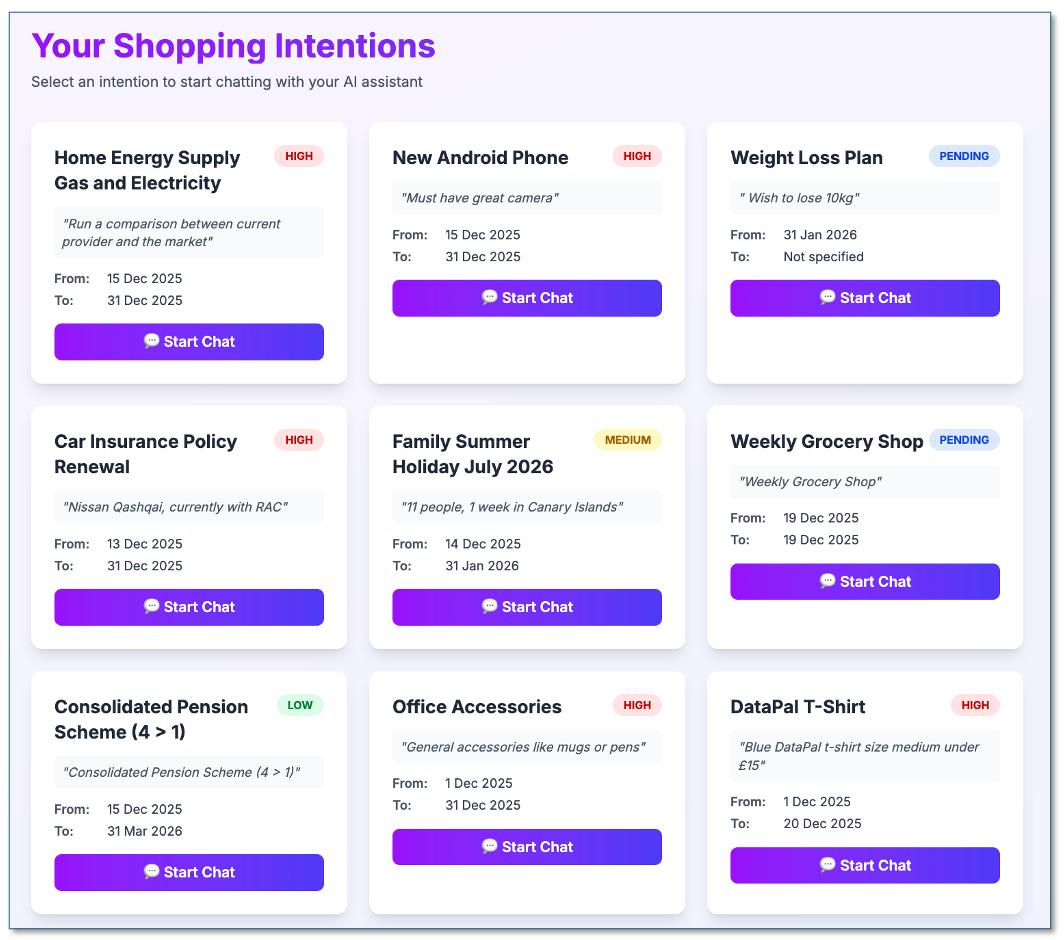
In some of those ‘still being worked out’ points, the emergence of MyTerms will really help. For example, agent identity’ is dealt with in the MyTerms agent appointment. ‘Who does this agent work for?’ is also addressed, in a MyTerms scenario, the delineation between ‘works for person’ and ‘works for an organisation’ are also very clear.
So how and why will this additional model enable and drive economic growth?
My start point for this in the fantastic Human Context Protocol paper from MIT Media Lab and others. The paper points to ‘Matching markets. There exist numerous matching markets where the addition of technology clarifying users preferences would be particularly useful’.
One of these markets alone, product discovery, powers the global digital advertising industry – worth over $600 billion – which fundamentally operates on the logic of reducing search frictions and facilitating product discovery. Human Context Protocol could enable an active discovery process from the user side, giving users increased latitude in the types of ads they see.
My ‘growth’ thesis then is actually really simple”.
We all know the old adage attributed to John Wannamaker that ‘50% of my advertising is wasted, I just don’t know which 50%…’. In my own 35+ year experience in advertising and marketing, I think the waste is much higher than 50%.
The reason for this huge waste is the relative weakness in the digital signals that drive current adtech, martech and sales promotional models. In a matching market scenario, if either of the two inputs to the matching exercise is weak then the match itself can only be sub-optimal. That is to say, there will be many false-positives. People who, from what is visible to the machine, may be ‘in market’ for a product or service category, but who in practice are not.
This is un-fixable in the current paradigm, in which the demand side/ individual inuitively or otherwise knows that they cannot and should not share any more than minimum context and intent data. (much of the point of current organisational approaches to ‘terms’ and privacy policies is to mask the current grab around anything that can be interpreted into ‘intent’ data).
But MyTerms changes that dynamic, and specifically does so with PDC-INTENT which is absolutely aimed at enabling people to safely share rich context and related intent data.
So, when input data to the matching process is much improved, the match itself will be much improved (a win for both parties).
People actively in the market are self-indentified in order to get the market information that they seek.
And those not in-market (or no longer in-market) also can be excluded from activity, thus eliminating significant amounts of waste.
Growth therefore comes from reduction in waste, which can be recycled into more productive uses. And then the many upsides that emerge from people finding the right product/ service/ solution to their requirements more quickly, easily and with significantly less exposure to widespread sharing of their peronal data.
Next up…., the related concept of ‘Product-Customer Fit’.
EXACTLY what we've been building Ian. Can you just be our ghostwriter!
Thanks for this, Iain. Very helpful. Also appreciate the link to the MIT paper and the logic of "matching markets" which is a powerful term in its simplicity re: parity and clarity.